By Live Like Sam | May 5, 2026 | 5 min read
Picture your fourteen-year-old at lunch. They are sitting with friends, headphones half-on, scrolling. From across the cafeteria they look fine. Maybe better than fine.
Now picture what is happening in their head.
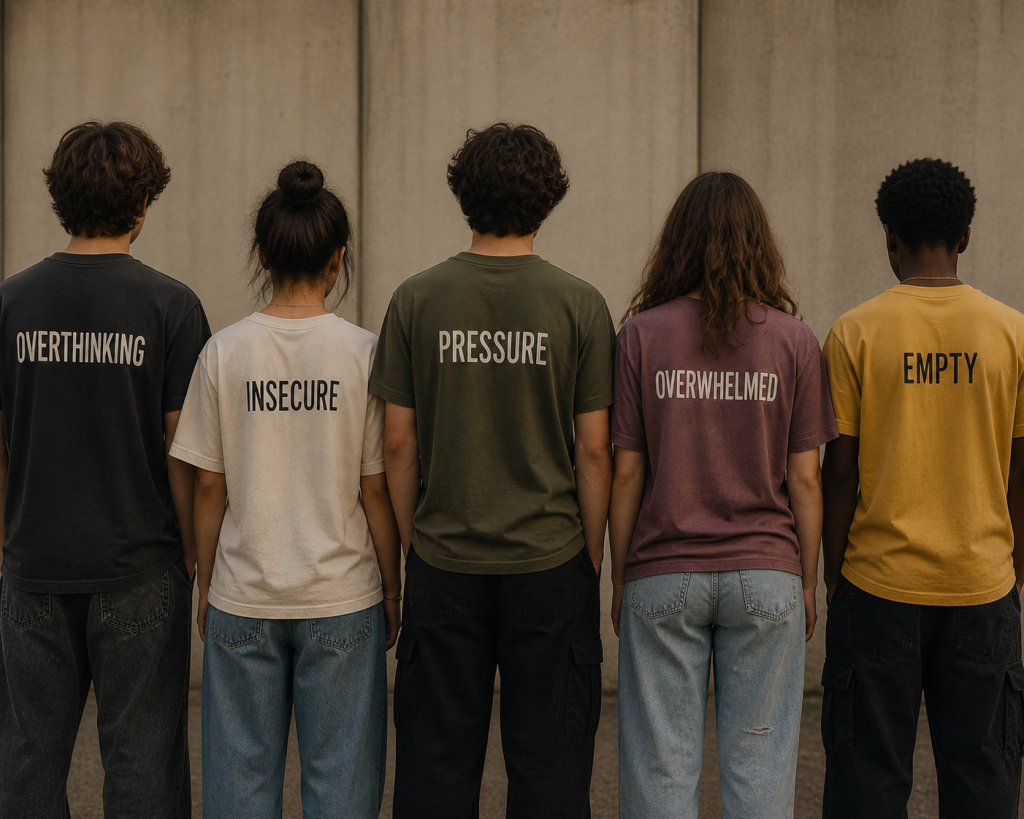
Some version of: everyone else has this figured out. Everyone else feels confident. Everyone else knows what they are doing. I am the only one who feels lost.
That is the confidence myth. And it is the single most common, and most quietly damaging, story teenagers tell themselves right now.
The data is hard to look away from
Recent CDC data tells us 2 in 5 high school students report persistent feelings of sadness or hopelessness. 1 in 5 adolescents experience anxiety severe enough to affect daily life. And the kicker, the one that should stop every parent in their tracks: a majority of teens with depression receive no treatment.
Why? Not because help is unavailable. Because they will not ask for it. They are too convinced that asking will confirm what they already believe about themselves: that something is wrong with them, and only them.
Self-doubt is normal. Silence is what makes it isolating.
Why this generation gets hit harder
Plenty of well-meaning adults will tell you, “we were teenagers once, this is just what teenagers do.” That is half right and half off.
Half right: yes, self-doubt has always been part of adolescence. The pulling away from parents, the questioning, the awkward middle distance between kid and adult, that is the deal. It is a rite of passage. It always has been.
Half off: today’s teenagers are making sense of that rite of passage in front of an audience of thousands, with a comparison feed in their pocket, in a culture that asks them to brand themselves before they have figured out who they are. The pressure to look figured out, all the time, is unprecedented. The doubt is not new. The amplifier is.
How the myth shows up at your dinner table
Watch for these tells:
They say “I am fine” about something that clearly is not fine. They will not name what they are feeling, even when you ask gently. They get quiet after a school day that included a hard moment with friends. They scroll for an hour and look worse, not better, when they put the phone down. They use the word “everyone” a lot. (Everyone is going. Everyone has one. Everyone gets it.)
Each of those is the myth doing its work.
What actually breaks it
Lectures will not. Reassurance will not, or at least not on its own. Saying “you are not the only one who feels this way” is technically true but emotionally weightless when your teen has spent the day collecting evidence that proves the opposite.
What does break the myth:
1. Specifics from your own teenage years.
Not the highlight reel. The specific, slightly embarrassing memory. The day you bombed the algebra test. The friend who stopped sitting with you at lunch. The party you were not invited to. “I remember being your age and feeling like everyone had a script I never got” is the kind of sentence that lands.
2. A different kind of question.
“How was your day” gets you nothing. Try: “What is one word that describes how today landed?” Or, “What is something most people would not guess about how this week has felt?” Lower the bar from explanation to one honest beat.
3. Other people’s words, said out loud.
This is where Same Inside comes in. When teens see other teens, parents, coaches, neighbors, all naming the words they carry, the myth gets harder to hold. The math stops working. If everyone has it figured out, then why is everyone posting overwhelmed, hopeful, tired, proud, scared?
The honest answer is: nobody has it figured out. The teenagers who think they do are usually the ones working hardest to seem that way.
The Same Inside connection
Our entire May campaign is built to bust the confidence myth. Pick a word, share it, pass it on. Three steps, no fixing required. The campaign works because participation is the medicine. Your teen does not need to read another article telling them they are not alone. They need to see, with their own eyes, that they are not.
And here is the thing most parents miss: this campaign is not just for teens. The fastest way to break the myth in your house is for you to go first.
TRY THIS WITH YOUR FAMILY
This week, pick a night. Everyone at the table picks one word for what they carried that day. No fixing, no follow-up questions, just listening. Then post one of those words, with permission, to your own social. Tag @livelikesam, use #SameInside, and let your teen see you do it.
Make yours together: livelikesam.org/sameinside
What Live Like Sam does about this.
Busting the confidence myth is not a one-conversation fix. It is what Live Like Sam programming does, every week, across Summit and Wasatch counties. Thrive, our six-week evidence-informed curriculum for grades 6 through 12, is built on exactly this principle: kids learn that what they carry is shared, not strange. In 2025, Thrive students reported 25% less anxiety and 21% less depression. That is the confidence myth losing its grip.
Thanks to the Dever Family Foundation and the Shear Family Foundation, every gift this May is matched up to $100,000. Your dollar becomes two. Your support reaches another kid earlier, before the myth has a chance to settle in.
Sources
CDC, Youth Risk Behavior Survey, 2023: cdc.gov/yrbs
National Institute of Mental Health, Major Depression Statistics: nimh.nih.gov
Substance Abuse and Mental Health Services Administration, National Survey on Drug Use and Health: samhsa.gov