By Live Like Sam | May 5, 2026 | 5 min read
There is a reason Same Inside asks for one word.
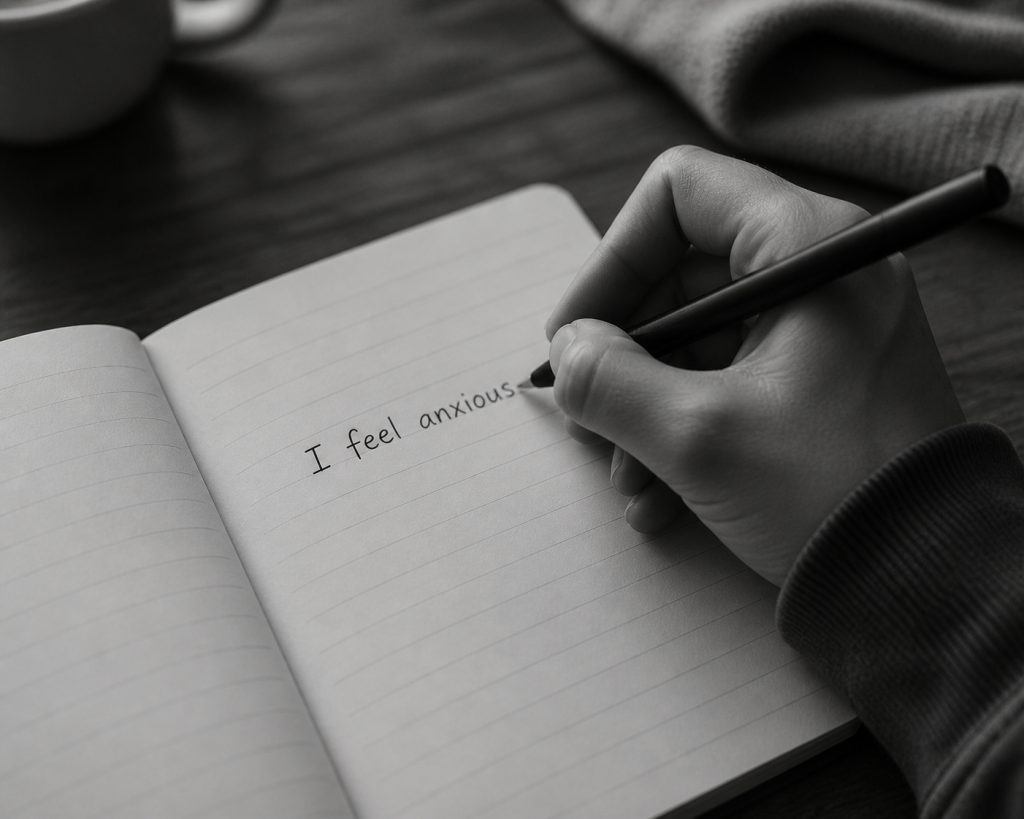
Not a paragraph. Not a journal entry. Not an explanation. One word. “Tired.” “Overwhelmed.” “Hopeful.” “Proud.”
That choice is not a marketing trick. It is built on a body of neuroscience research that has been around for two decades and is becoming more relevant with every passing year your teenager spends online.
It is called affect labeling
In the early 2000s, researchers at UCLA put people in MRI scanners and showed them images that triggered an emotional response. Then they asked half of them to put a word to what they were feeling. The other half just sat with it.
The findings were striking. When participants named the emotion, activity in the amygdala (the brain’s threat-detection center) went down. Activity in the prefrontal cortex (the part of the brain that helps us reason, plan, and regulate) went up.
The shorthand researchers and clinicians use for this is “name it to tame it.” Putting language to a feeling, even one word of language, shifts your brain from reactive mode toward thoughtful mode. It does not make the feeling disappear. It makes it manageable.
The simplest emotional regulation tool we know of is also the one most families have stopped using: saying out loud what you actually feel.
Why this is a big deal for teenagers
The teenage brain is in the middle of a pretty wild renovation. The emotional center is fully online and turned up loud. The regulatory center, the prefrontal cortex, is still under construction and will not finish until the mid-twenties. That mismatch is why your fourteen-year-old can have a ten-out-of-ten meltdown about a charger.
Affect labeling is one of the few tools that meets a teenage brain where it actually lives. It does not require introspection. It does not require a forty-five-minute conversation. It does not require parents to say the right thing. It just requires a word.
Why “are you okay” does not work
Most of us, when we sense a kid is off, default to: “Are you okay? Is everything alright? What is going on?”
Those questions feel caring. They are caring. But the brain on the receiving end of them often hears: “You owe me an explanation. Right now. Use full sentences.”
That is too much. That is the wrong size of ask for an exhausted teenager. They will say “yeah” and you will let it drop and the moment will close.
Try instead: “What is one word for today?”
It is small. It does not demand a story. It gives your teen permission to name something true, fast, with no follow-up required. (And you do not need a follow-up. The naming is the work.)
The dinner table experiment
Try this for one week. At dinner, before anyone eats, every person at the table says one word for what they carried that day. Anyone can pass. No one is allowed to ask follow-up questions. No one is allowed to fix anything. You just go around. Words land. Bread is passed.
Most families who try this report two things by night three. First, the kids start arriving at dinner with their word ready. Second, the words get more honest fast. “Fine” becomes “frustrated” becomes “embarrassed” becomes “scared.”
The brain mechanism is the same one studied at UCLA. The setting is your kitchen. That is the whole point of Same Inside, scaled down to a household.
Why we built a whole campaign around it
If naming a feeling can shift a brain, imagine what naming a feeling can do to a community.
That is the bet behind Same Inside. When one teenager posts “overwhelmed,” another teenager scrolling at midnight realizes they are not the only one. When a parent posts “tired,” their kid sees that grown-ups feel it too. When a coach, an aunt, a neighbor, all post their words, the silence that has been doing the most damage starts to lift.
One word is small. A community of words is not.
TRY THIS WITH YOUR FAMILY
This week, run the dinner table experiment. One word from each person, every night. Then, on a night that feels right, pull out your phones together, write your words on the Same Inside template, post them, and nominate three people you want to hear from. Doing it together is the whole point.
Make yours together: livelikesam.org/sameinside
This is Live Like Sam.
Every program we build is built on the same idea: kids learn to handle hard feelings the same way they learn anything else; with practice, language, and adults who go first. Thrive teaches teens the language. Sages & Seekers gives them the conversations. Challenge Accepted gives them the chance to try and fail safely. Digital Wellness helps them name what scrolling actually feels like. Different doorways. One room. Free, every program, across Summit and Wasatch counties.
Same Inside is the public version of this private work. One word, said out loud, multiplied across a community. Every word your family shares this May does what the science predicts – it shifts one brain at a time, and gives someone else permission to do the same.
Thanks to the Dever Family Foundation and the Shear Family Foundation, every gift this May is matched up to $100,000. Your support reaches another kid who learns to say what they feel and life gets lighter when they do.
Sources
Matthew D. Lieberman et al., “Putting Feelings into Words: Affect Labeling Disrupts Amygdala Activity in Response to Affective Stimuli,” Psychological Science, 2007.
Daniel J. Siegel, The Developing Mind: How Relationships and the Brain Interact to Shape Who We Are (Guilford Press, 2020).
National Institute of Mental Health, The Teen Brain: nimh.nih.gov/health/publications/the-teen-brain